
Scroll through Facebook for more than a few minutes and there is a good chance you will run into an ad that looks like a game. Bright colors, spinning coins, a plane climbing higher and higher before it crashes, a small basket of fruit lining up for a jackpot. It looks playful. It looks harmless. But look closer and you will often find a real money app hiding behind the cartoon graphics.
This is not a small trend. It is a global pattern, and it is happening on one of the biggest platforms in the world. In this post we will break down how Facebook gambling ads work, why they are so effective, why regulators around the world are struggling to stop them, and what this looks like specifically in Pakistan, where online gambling is completely illegal yet somehow still advertised.
We will also look at the psychology behind these ads, the loopholes that let them slip through review systems, and what you as a user can actually do about it.
Games like:
– Royal X Casino Latest Version 2026 – Detailed Guide
– KHAN804 Game APK: The Same Deposit Table as Another App
– TR2026 Game Review: TR2026 APK, TR Game 2026 Register and Login Explained – RozgarApps.com.pk
– 188PKR App Review: APK, Register and Login Guide 2026
– XK777 Login APK: The File Isn’t Named XK777, Login & Bonuses
– T 7777 Game Review, Is T 7777 Safe? What We Found in the App
Table of Contents
What Counts As A Gambling Ad On Facebook
Before going further, it helps to define terms clearly for anyone trying to make sense of Facebook gambling ads.
Meta itself defines online gambling and gaming as any product or service where something of monetary value is part of how you enter or what you can win. That covers a wide range of activities, including:
- Sports betting apps
- Online casinos and slot games
- Poker platforms
- Lottery and raffle style apps
- Bingo apps
- Skill based tournaments with cash prizes
There is also a separate category that matters a lot here, especially when talking about Facebook gambling ads: social casino games. These are apps that mimic gambling mechanics, spinning wheels, slot reels, card games, but use virtual coins that cannot be exchanged for real money. On paper, this makes them exempt from gambling regulation. In practice, the line between a social casino app and a real money gambling app is often just one small feature away, and many apps blur that line on purpose.
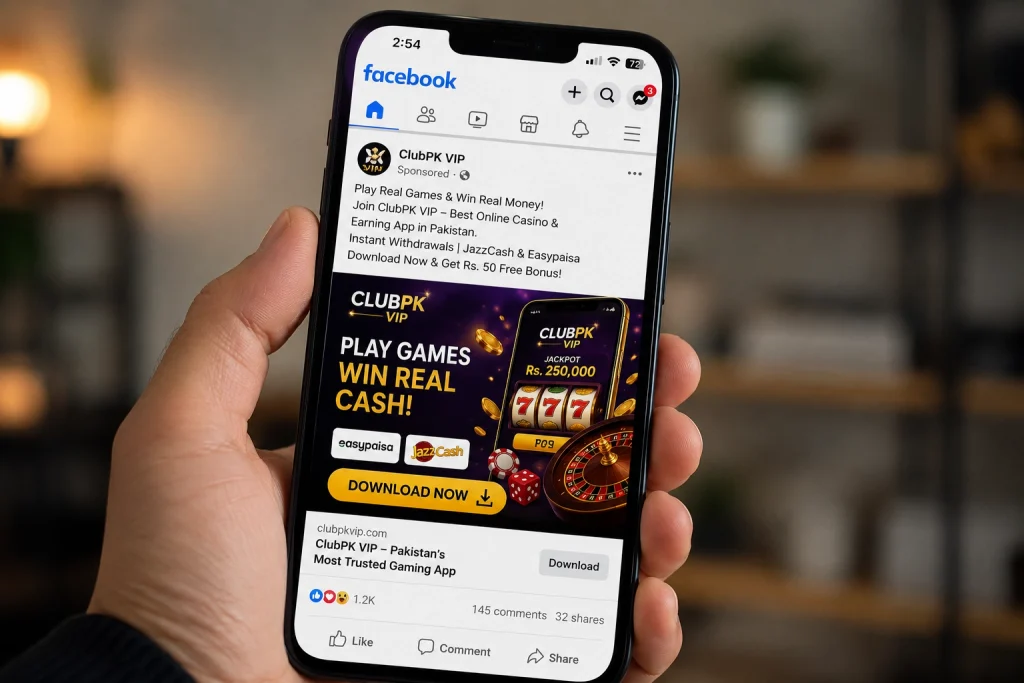
This is where the phrase gambling apps real money becomes important, since it explains why online gambling and casual gaming keep overlapping. Some apps start as free to play social casinos, then slowly introduce real money deposits and withdrawals once a user is hooked. Others advertise themselves as skill based games while functioning almost identically to a slot machine, and many of them still find their audience through Facebook gambling ads.
Why Online Gambling Has Moved Onto Social Platforms
Ten years ago, most online gambling happened on dedicated betting websites. You had to search for them, sign up on a standalone site, and often use a separate payment method that felt distinctly different from everyday spending.
That world has changed a lot.
Smartphones turned gambling into something that fits inside a five minute break. Social platforms turned it into something that finds you, rather than something you have to search for. Facebook, with its billions of daily users and extremely detailed targeting tools, became one of the most efficient distribution channels ever built for reaching potential gamblers at scale, which is a big part of why Facebook gambling ads feel so common today. Payments are easily done through JazzCash and Easypasia.
A few shifts explain why this move happened.
- Mobile payment systems made it far easier to deposit small amounts quickly
- Video based ad formats made gambling mechanics easy to demonstrate in a few seconds
- Algorithmic targeting let advertisers find people already interested in adjacent activities, such as fantasy sports or trading apps
- Global smartphone growth opened up huge new audiences in regions with weaker regulatory infrastructure
For advertisers, this created an incredibly efficient loop. For regulators, it created a moving target that crosses borders instantly, since an ad approved in one jurisdiction can technically be viewed by someone sitting in a country where the same product is completely illegal.
This is the backdrop that makes the rest of this story make sense. It is not that gambling suddenly became more common. It is that the distribution method changed faster than the rules meant to contain it.
Meta’s Official Policy On Gambling Ads
To be fair to Meta, the company does have a formal policy in place for Facebook gambling ads. Advertisers who want to run gambling and gaming ads where money is involved must first apply for authorization. Once approved, they still have to follow a long list of rules.
Here is a simple breakdown of what the policy requires.
| Requirement | What It Means |
|---|---|
| Authorization | Advertisers must be approved by Meta before running gambling ads |
| Licensing proof | Advertisers must show valid gambling licenses for every market they target |
| Age targeting | Ads cannot be shown to anyone under 18 |
| Market restrictions | Ads cannot run in countries where gambling is illegal or unsupported |
| Per account approval | Authorization is tied to a specific ad account, not the whole company |
| Per territory approval | A license approved for one state or country does not carry over to another |
On paper this sounds fairly strict. Meta has also tightened these rules further over time. In 2025, Meta expanded its definition of gambling to include virtual currency games that can be converted into real prizes, closing what used to be an obvious loophole.
So if the rules look this solid, why do so many people still see Facebook gambling ads in places where gambling is banned entirely.
The Gap Between Policy And Reality
This is where things get uncomfortable for Meta and for anyone trying to trust that Facebook gambling ads are properly screened.
Investigative reporting from Rest of World, a nonprofit newsroom focused on technology outside the West, found that Meta ran hundreds of gambling ads that broke both local laws and Meta’s own stated policy. These Facebook gambling ads were found running across at least 13 countries where gambling advertising is banned.
Some numbers from that investigation:
- Over 170 gambling ads ran in the Philippines in a single month, promoting an app called PH988
- At least 140 banned gambling ads were found running in India in December alone
- Nearly 1000 similar ads were tracked across Malaysia, Singapore, Saudi Arabia, Pakistan, and other countries where such ads are illegal
- Over 2400 additional ads had already gone inactive by the time researchers reviewed them, but many of the pages behind them were still active on the platform
A pattern noticed by researchers is that many of these ad pages use fake business addresses and run their campaigns for very short windows, sometimes only six to eight hours, before disappearing. This makes it extremely difficult for regulators, watchdog groups, or even Meta’s own review systems to catch them in time.
This is the core problem. Meta’s written policy is reasonably strong. Meta’s enforcement of that policy, at least according to outside investigators, is not keeping up.
Gambling Apps Pakistan: A Case Study In Contradiction
Pakistan is one of the clearest examples of this gap between rule and reality, and it deserves its own section.
Online gambling is fully illegal in Pakistan. This is not a gray area. The legal foundation goes back to the Prevention of Gambling Act of 1977, which bans gambling activity outright. More recently, the Prevention of Electronic Crimes Act, known as PECA, has extended this further by treating the hosting of online gambling apps or websites as a cybercrime, with penalties that are more serious than those for traditional gambling houses.
In August 2025, Pakistan’s National Cyber Crime Investigation Agency, or NCCIA, banned 46 mobile applications tied to illegal betting, unregulated online casinos, and unauthorized financial trading. Some of the apps named in that ban include:
- 1xBet
- Aviator Game
- Dafabet
- 22Bet
- Betway
- Melbet
- Parimatch
- Bet365
- Plinko
- Rabona
- Casumo
- 10Cric
- BetWinner
- 888Starz
- Thunderpick
- Chicken Road


The agency also flagged several of these apps for collecting personal data without consent, including SIM registration details and mobile numbers, raising privacy concerns on top of the gambling issue.
Yet despite this ban, and despite the underlying religious and legal opposition to gambling in Pakistan, which traces back to Islamic teachings that treat games of chance as forbidden, the same Rest of World investigation found gambling ads for apps like these still circulating on Facebook and reaching users inside the country.
This creates a strange situation. On one hand, the state has clearly and repeatedly declared these apps illegal. Law enforcement has the legal authority to block access and pursue operators. On the other hand, a foreign platform operating inside the country continues to serve Facebook gambling ads for the exact category of app that has been outlawed.
Pakistan’s regulatory approach in 2026 has shifted toward what officials call a filter and fine strategy, meaning digital firewalls block known betting domains while authorities also explore taxing associated financial activity. There is also a small carve out for two state sanctioned exceptions, tote betting on horse racing and National Prize Bonds, though even the second one remains controversial among religious scholars.
None of this changes the core contradiction though. A country with strict gambling laws and active enforcement still has residents scrolling past Facebook gambling ads for gambling apps Pakistan has already banned by name.
Real Money Games Versus Social Casino Games
A lot of confusion around this topic comes from the fact that two very different products can look almost identical on screen.
On one side you have real money games. These are apps where a user deposits actual currency, plays a game of chance or skill, and can withdraw winnings in real currency. This category includes sports betting apps, online poker rooms, and casino style apps that accept cash deposits, and it is exactly the category most often promoted through Facebook gambling ads.
On the other side you have social casino apps. These use the same visuals, spinning reels, card tables, roulette wheels, but run entirely on virtual currency that has no cash value and cannot be withdrawn.
Here is a side by side comparison to make the distinction clearer.
| Feature | Real Money Games | Social Casino Games |
|---|---|---|
| Deposits | Real currency | Often free, sometimes small in app purchases |
| Withdrawals | Real currency, if allowed by license | Not possible, coins have no cash value |
| Legal classification | Regulated gambling | Usually classified as entertainment |
| Age requirement | Strictly 18 or older | Often marketed more broadly |
| Regulatory oversight | Requires licensing in most countries | Minimal oversight in most regions |
| Advertising rules on Meta | Requires authorization | Generally exempt |
The problem is that this line is not always respected in practice. Some apps start out purely as social casinos, build a large user base under lighter regulatory scrutiny, then quietly introduce a cash out feature once the user base is established. Others operate in a legal gray zone where coins can be traded on secondary markets or exchanged for gift cards, effectively creating a real money game while technically avoiding the label.
This is exactly the loophole Meta tried to close in 2025 by expanding its definition of gambling to include virtual currencies that convert into real prizes. Whether that expanded definition is being consistently enforced is a separate question, and based on the investigative reporting covered earlier, enforcement still lags behind the policy on paper.
How Gambling Apps Disguise Themselves As Gaming Apps
One reason these Facebook gambling ads slip through review systems and slip past user suspicion is that they are built to look like games, not gambling products.
Here are some of the most common disguise tactics.
Virtual currency framing
Instead of saying deposit money and win cash, the app uses language like collect coins, spin for rewards, or unlock bonus rounds. This makes the activity feel closer to a mobile game like Candy Crush than a casino.
Crash and multiplier games
Games like Aviator and Chicken Road present themselves as simple reflex based games. A plane climbs, a chicken crosses a road, and the player decides when to cash out before it crashes. The mechanic is genuinely simple, which is part of why it spreads so easily, but the underlying structure is still a betting game where losing is far more common than winning.
Free trial hooks
Many apps let new users play with free credits at first. Once someone gets a small early win, the app nudges them toward depositing real money to keep playing at a higher level.
Withdrawal proof and social validation
Ads often show fake screenshots of large withdrawals, testimonials, or countdown timers suggesting a limited time bonus. This creates a sense of legitimacy and urgency at the same time.
Referral and bonus language
Words like referral bonus, cashback, and loss rescue appear frequently in these ads. They suggest that even losing money comes with a safety net, which is rarely true in practice.
The table below sums up the difference between how these apps present themselves and what they actually are.
| What The Ad Says | What Is Actually Happening |
|---|---|
| Collect free coins | Coins are often designed to convert into real money deposits later |
| Simple fun mini game | Underlying mechanic is a betting system with house odds |
| Instant withdrawal | Withdrawal terms are often buried, delayed, or conditional |
| Loss rescue bonus | Encourages continued deposits after a loss |
| Skill based game | Outcomes are frequently randomized or weighted against the player |
The Psychological Playbook Behind These Ads
Understanding why these Facebook gambling ads work requires looking at basic behavioral psychology, not just marketing tricks.
Near miss effect
Slot style games are often designed so that a loss feels almost like a win. Two matching symbols and one that just barely misses trigger the same excitement in the brain as an actual win, encouraging another attempt.
Variable reward schedules
Unlike a fixed reward, where you know exactly what you will get, a variable reward, where the outcome is unpredictable, is far more addictive. This is the same mechanism behind slot machines in physical casinos and it applies directly to these mobile equivalents.
Sunk cost pressure
Once someone has already spent money, there is a strong psychological pull to keep going in hopes of recovering the loss. Loss rescue bonuses are specifically designed to tap into this instinct.
Social proof and urgency
Fake reviews, fabricated withdrawal screenshots, and countdown timers create a false sense that other people are winning right now and that time is running out to join them.
Targeting vulnerable groups
Reports have repeatedly raised concerns that Facebook gambling ads disproportionately target people in lower income regions, younger users despite age restrictions, and individuals already dealing with financial stress. This raises serious ethical questions about who these ads are really designed for.
The Business Incentives Nobody Talks About
It is worth stepping back and asking a simple question. Why would a platform allow this pattern to continue if it clearly conflicts with stated policy.
The honest answer involves money, scale, and priorities, not necessarily bad intent.
Advertising revenue is enormous
Gambling and gaming advertisers, including fully licensed and legitimate ones, spend heavily on digital advertising. Platforms that host high volumes of ad traffic have a financial incentive to keep that category active, even while trying to filter out the illegal portion of it.
Scale makes perfect enforcement almost impossible
Billions of ads run across Meta’s platforms every year. Even with a large trust and safety team, catching every violation before it reaches users is closer to an ongoing chase than a solved problem.
Whack a mole dynamics
When one page or advertiser account gets banned, a new one can often be created within hours. Without stronger identity verification requirements, this cycle repeats endlessly.
Regional inconsistency in enforcement priority
Some markets receive more regulatory attention and media scrutiny than others. Investigative reporting has shown that enforcement gaps tend to be worse in regions with less media coverage, weaker regulatory pressure, or lower ad revenue per user, which unfortunately includes many of the same countries where these ads are already illegal.
None of this excuses the outcome. It does explain why the gap between written policy and daily experience continues to exist, and why closing it requires more than just adding new rules to a policy page.
Why Enforcement Keeps Failing
If Meta has a policy, and countries like Pakistan have laws against this activity, why does enforcement of Facebook gambling ads keep falling short.
There are a few structural reasons.
- Short ad lifespans. Many of these campaigns run for only a few hours before being taken down and replaced with a new page. By the time a report is filed and reviewed, the ad may already be gone, only to reappear under a different name.
- Fake business information. Ad pages frequently list fake addresses or shell company details, making it hard to trace who is actually behind the campaign.
- Automated review limits. Meta relies heavily on automated systems combined with human reviewers to catch policy violations across a massive volume of ads. Even with tens of thousands of reviewers globally, the sheer scale of daily ad submissions makes perfect enforcement extremely difficult.
- Jurisdiction mismatch. An ad might be created and approved from one country while being served to users in a completely different country with different laws, complicating who is actually responsible for stopping it.
- Financial incentive. Gambling and gaming advertisers, including legitimate ones, represent a large source of ad revenue. This does not mean enforcement is intentionally weak, but it does mean there is less urgency compared to categories with smaller commercial value.
A Global Snapshot Of The Same Problem
Pakistan is far from alone. The same investigation that uncovered Facebook gambling ads running in Pakistan also found similar patterns across a wide range of countries, each with its own legal stance on online gambling.
| Country | Legal Status Of Online Gambling | Reported Ad Activity |
|---|---|---|
| Pakistan | Fully illegal under the 1977 Act and PECA | Ads for banned apps still found running |
| India | Illegal or heavily restricted in most states | At least 140 banned ads found in one month |
| Philippines | Regulated with specific licensing bodies | Over 170 ads for one unlicensed app found in a month |
| Malaysia | Largely illegal outside limited exceptions | Included among 12 additional countries with banned ad activity |
| Saudi Arabia | Fully illegal | Included among countries with banned ad activity |
| Singapore | Heavily restricted with licensing requirements | Included among countries with banned ad activity |
Seeing this pattern repeated across such different legal, cultural, and economic contexts tells us something important. This is not a Pakistan specific failure or an isolated oversight in one region. It is a structural weakness in how a global advertising platform manages an activity that is regulated very differently from country to country.
It also means the solution cannot rely purely on local enforcement. Regulators in any single country can block domains, fine operators, and ban named apps, but as long as the ad distribution system itself operates globally with inconsistent enforcement, new versions of the same ads can keep appearing under different names.
What You Can Do As A User
Even with these systemic issues, there are practical steps you can take right now.
Use Facebook’s own ad controls
Facebook allows users to hide specific ads and mark categories of ads as not relevant. Doing this consistently for gambling related ads can reduce how often they appear in your feed over time.
Report suspicious ads directly
If you see an ad promoting gambling in a region where it is illegal, or one that seems deceptive, use Facebook’s built in reporting tool. This creates a record and, at scale, contributes to takedown decisions.
Be skeptical of coin based games
If an app frames everything around collecting coins but also offers a way to convert those coins into cash or vouchers, treat it the same way you would treat an actual gambling product.
Watch for red flags in the app itself
- Unclear or missing licensing information
- Withdrawal process that is vague or delayed
- Pressure to deposit more after a loss
- Reviews that all sound suspiciously similar
- Requests for excessive personal data, such as SIM or ID details
Talk to younger users in your household
Since these apps often use gaming aesthetics, younger users may not immediately recognize them as gambling products. A short conversation about how these ads work can go a long way.
Frequently Asked Questions
Why do I see so many Facebook gambling ads even though I never search for gambling content
Facebook’s ad system relies on broad behavioral signals, not just direct searches. Interacting with content related to sports, trading, or even casual mobile games can be enough to place you into an audience segment that gambling advertisers target.
Are social casino games actually gambling
Not legally, in most places, since no real money changes hands. However, many researchers argue that the psychological mechanics are close enough to real gambling that they can normalize gambling behavior, especially among younger users.
Is it illegal for me to use a gambling app if I live in a country where gambling is banned
In many countries, including Pakistan, using an illegal gambling platform can carry legal risk for the individual user, not just the operator. Laws vary, so checking local regulations is important before assuming personal use is risk free.
Can I actually stop Facebook from showing me these ads
You can reduce their frequency significantly using Facebook’s ad preference tools and by consistently marking gambling related ads as not relevant, but you may not be able to eliminate them entirely given how ad targeting systems work.
Does reporting an ad actually do anything
Individual reports contribute to a larger pattern that platforms use to identify problematic advertisers, especially when combined with reports from many users. It may not remove a specific ad instantly, but it does feed into enforcement decisions over time.
What is the difference between online gambling and a social casino app
Online gambling involves real currency, meaning you deposit real money and can withdraw real winnings if the platform is licensed. A social casino app looks the same on screen but runs on virtual coins that carry no cash value, which is why many Facebook gambling ads blur this line to make a product look safer than it actually is.
Are gambling apps Pakistan has banned still available to download
Officially no, since the NCCIA ban directs the Pakistan Telecommunication Authority to block access to the named apps. In practice, some users still find ways around the block through mirrored links or renamed versions, which is part of why Facebook gambling ads for similar apps keep resurfacing even after a formal ban.
Final Thoughts
The core issue here is not that Meta has no rules. It clearly does, and on paper those rules are fairly comprehensive. The issue is the space between policy and practice, a space wide enough for illegal Facebook gambling ads to keep reaching users in countries where those very apps have been banned by name.
Pakistan is a striking example of this. A country with a nearly fifty year old law against gambling, a modern cybercrime framework that treats hosting these apps as a serious offense, and a government agency that has publicly named and banned dozens of these platforms, still has residents encountering Facebook gambling ads for similar apps.
This is not just a regulatory failure story. It is also a design story. These apps are built using the same psychological principles that make traditional gambling addictive, wrapped in the visual language of casual mobile games. That combination is exactly why they spread so effectively and why they are so hard to fully shut down.
Until enforcement catches up with policy, the most reliable protection is awareness. Knowing how these ads are built, why they work, and what red flags to look for puts the decision back in your hands, even when the platform itself has not fully closed the gap.
There is also a broader lesson here that goes beyond gambling specifically. Any platform that mixes global reach with locally different laws will always struggle to enforce those laws perfectly. Content moderation at this scale is not a single switch that gets flipped on or off. It is an ongoing process involving automated systems, human review teams, government pressure, investigative journalism, and user reports, all working together imperfectly.
What makes Facebook gambling ads a particularly important test case is the direct financial and psychological harm involved when the system fails. A missed moderation call on a low quality ad is a minor annoyance. A missed moderation call on a gambling ad targeting someone already struggling financially, in a country where that product is explicitly illegal, is a much more serious failure with real consequences for real people.
For readers in Pakistan specifically, the practical takeaway is straightforward even if the regulatory picture is complicated. The law is clear that these gambling apps Pakistan has banned are illegal. The NCCIA has published specific app names. Encountering a Facebook gambling ad for one of these apps does not make the activity legal, and using one still carries real legal and financial risk regardless of how the ad presents itself.
For readers anywhere else, the same core principle applies. Just because an ad appears on a trusted platform does not mean the product behind it has been fully vetted against your local laws. Platforms are working on this problem, slowly and imperfectly, but the burden of a final check still tends to fall on the person scrolling through their feed.
That is not a fully satisfying answer, but it is an honest one, and understanding it is the first real step toward protecting yourself from a system that has not caught up with its own stated rules yet.
Written by
RozgarApps teams has done this article “Facebook Gambling Ads” to clarify why users are getting ads on their phones about the slots, aviator and other gambling apps. If you want to get in touch with us visit our homepage or contact us page.